Page 1 of 1
SU carb, what is this??
Posted: Sun Jul 24, 2016 8:51 am
by Mark Taxis
Hi
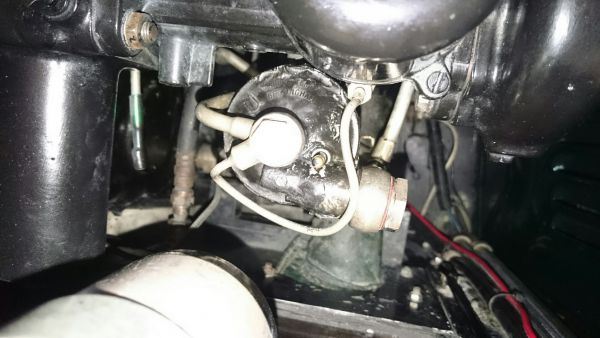
Can anyone tell me what the pipe is that goes from the top of the float chamber to the body of the carby, is is a sort of vapour vent?
Posted: Sun Jul 24, 2016 9:00 am
by Christopher Carnley
It is describes as an air bleed for when the chambers are being filled.
Posted: Sun Jul 24, 2016 10:07 am
by Mark Taxis
Thank you for the info Christopher,
I have never seen these on any other makes of car, in all honesty I do not understand why they are fitted, the overflow pipe would also act as an air breather
Posted: Sat Oct 08, 2016 8:42 am
by Mark Taxis
Have found that the pipe on the front carby is blocked and the other one is broken, car appears to run normally, I am considering removing them and blanking off the hole on the carbies.
I cannot find any records or pictures of these pipes on any other SU set ups, in fact other Mk 6 that I have looked at are not fitted with these tubes, so I am wondering as to whether or not they actually do anything
Posted: Sat Oct 08, 2016 12:12 pm
by John Robins
They are certainly present on my R-type.
Posted: Sat Oct 08, 2016 12:21 pm
by Mark Taxis
Well like everything they are there for a reason, but are they important - i don't know

Posted: Fri Jan 27, 2017 6:39 am
by Mark Taxis
The following is a message from Norman Gleeson explaining the use of these breather pipes, all interesting stuff, many thanks Norman
As you have found the particular float chamber to jet well pipe on EPW six cylinder engines cannot be found on any other engine. The arrangement is unique to the S.U .thermo H series four bolt carburettors used on the four port intake manifold.
These carburettors were first used on the early 1949 MKVI 4.5 Ltr (and subsequent 4.25 ltr) engines. A problem arose with flat spotting when accelerating during trials. Investigation found that if a small bore pipe was linked between the float chamber top and the jet well this would emulsify fuel in the jet well before it egressed from the main jet and this fix eliminated the problem.
During investigation into issues with the late R Type engines it was found that temporary removal and blanking of the jet well adapter still prevented the former flat spotting. Still further trials found that the original problem had been caused because the volume of the original jet well was too small. The jet well volume had been increased by the casting in the boss for the pipe adapter. A small number of R Type Continental engines had the pipes removed to richen the mixture and dampen the exhaust burble on overrun. If the pipes are removed some extra care may be needed in selecting the main needles as in certain conditions the mixture is altered by 7%.
The adaptors, which are screwed into the carburettors, are also fine jets and you would be advised not to try to remove them from the alloy carburettor bodies.
The pipes are nothing to do with chamber filling, chamber breathing, and deliberate weakening or vapour venting. Parts book descriptions apart they could be more accurately described as air injectors, or jet well emulsifiers.
I trust this satisfies your curiosity?