Page 1 of 1
Hemispherical nuts
Posted: Sun Dec 03, 2017 10:10 am
by Steve Welton
1913 Sunbeam 12-16
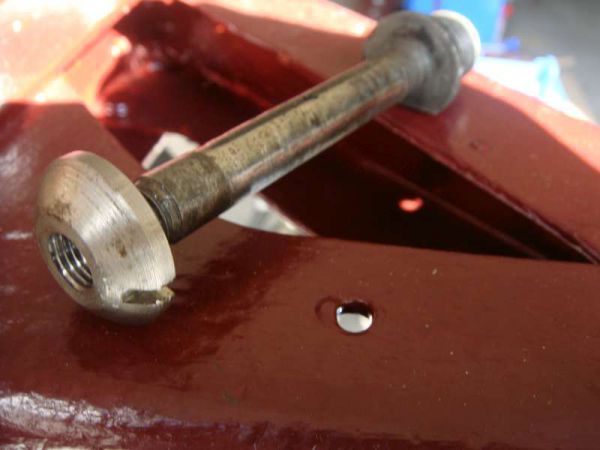
I wonder if anybody knows why Sunbeam (and possibly other car manufacturers) used a shallow hemispherical nut on their shackle pins? Why not use hexagonal nuts?
Posted: Sun Dec 03, 2017 12:33 pm
by Robert Craven
Perhaps so they can't be undone except with a special tool.
Posted: Sun Dec 03, 2017 10:11 pm
by John Murch
Would they be tighened up at the other end and the slot in the hemispherical nut pull into a suitable protuberance, althouth one wonders why!
Or is there an access problem which is solved by a ‘C’ spanner (seems unlikely)
Posted: Mon Dec 04, 2017 8:54 am
by Steve Welton
Thank you for responses to date. The shackle pin in the picture is from the rear spring, three-quarter elliptical setup. The head of the shackle pin is circular with one flat, this can just be seen in the picture. The flat is located and therefore held by a lug on the swing link preventing it turning.
At the front of the car the shackle pin head is completely circular and located by a peg which locates in a hole in the dumb iron thus preventing it turning.
The hemispherical nut I believe would have been tightened using a pegged spanner or socket. In all the shackle pins I have seen there was no arrangement for a split pin or any other locking device.
Through the VSCC forum I learn that Stanley steamers had something similar.
I just want to know why use the hemispherical nut?
Posted: Thu Dec 07, 2017 11:43 pm
by Stephen Blakey
I've seen reference in engineering textbooks to the use of hemispherical nuts when the bolt is subject to deflections which would require the nut to tilt on its seat to avoid a stress concentration where the bolt enters the nut. Of course the nut would have to be the other way round.
Maybe they changed their minds after ordering the nuts?
Posted: Fri Dec 08, 2017 10:12 am
by Christopher Carnley
Yes but you are referring to "spherical seating", quite common on the pre-war cars.
Posted: Fri Dec 08, 2017 11:48 am
by Stephen Blakey
"And" would be more positive than "but". Agreed anyway.
Posted: Fri Dec 08, 2017 12:12 pm
by Christopher Carnley
I am of course using the preposition, and not the conjunction.
Posted: Fri Dec 08, 2017 1:11 pm
by Stephen Blakey
Naturally.
Posted: Fri Dec 08, 2017 3:22 pm
by Christopher Carnley
There is an interesting article in The XXX,s, p3, "Eating chips stops riots"!
Posted: Fri Dec 08, 2017 6:06 pm
by Steve Welton
Pleased to read this is getting somewhere...............
Posted: Fri Dec 08, 2017 6:15 pm
by John Murch
Steve Welton wrote:Pleased to read this is getting somewhere...............
Is it? I’m fascinated but quite lost!
John
Posted: Fri Dec 08, 2017 7:12 pm
by Steve Welton
Let me be clear this was the first post of this thread:
"I wonder if anybody knows why Sunbeam (and possibly other car manufacturers) used a shallow hemispherical nut on their shackle pins? Why not use hexagonal nuts? "
I would genuinely like to find an answer.
Posted: Sat Dec 09, 2017 5:51 am
by John Murch
Have you tried asking Colin Weyer -
http://www.sunbeam.org.uk/Sunbeam.htm
There is contact info on this website. Or was this a Sunbeam feature that didn’t extend into the vintage period?
John.
Posted: Sat Dec 09, 2017 7:12 am
by Steve Welton
I am fairly well connected with Sunbeam Gurus and have been asking this question for two decades without a satisfactory rational explanation of the practice. I have recently extended my quest into other old car places in the hope that there is some knowledge that may lead to an answer.
The hemispherical or domed nuts continued to be used until the early 20s there is a picture of them in the parts list for a 1920 16HP they were consistently used on cars before the first world war. Not used after about 1922/3.
Posted: Sat Dec 09, 2017 9:52 am
by Paul Spencer
Is there a clue there? Did something change in metallurgy or techniques in the early 1920s that could have caused people to stop using them?
Posted: Sat Dec 09, 2017 10:05 am
by Christopher Carnley
The rationale may be that the makers did,t want any "garage" tinkerer undoing the parts, the "proper" man would have had the special tools.
Or they had them recessed making it inaccessible for the spanners.
Or else Louis Coatalen did,nt like the "ordinary" nuts and bolts, or they had difficulty in making them.
Do the bolts have hexagonal heads?
Posted: Sun Dec 10, 2017 9:05 am
by Steve Welton
There were two types of shackle pin head. One is completely circular and located by a peg which locates in a hole in the dumb iron or swing link thus preventing it turning. The other has a flat which locates against a lug which has been cast on the swing link.
Posted: Sun Dec 10, 2017 10:13 am
by Christopher Carnley
Is the nut end located in a recess, such that only a demi-lune faced "socket" with two driving keys can tighten/remove it?
Fashion and competition along with specialist manufacture of nuts and bolts eliminated these specialities after 1919.
Posted: Sun Dec 10, 2017 5:06 pm
by Steve Welton
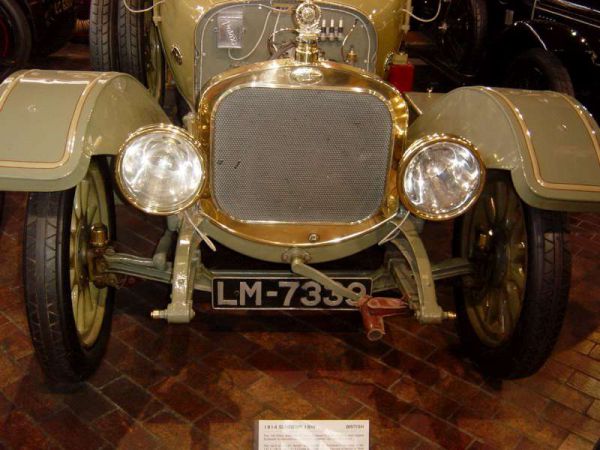
No Christopher these are not in a recess although I suspect a socket rather than a twin hooked spanner was used. There is a picture of the Beaulieu 12-16 you can see the set up on the inside face of the front dumb irons. They were also used on the swing links front and rear.
Posted: Sun Dec 10, 2017 6:38 pm
by Christopher Carnley
Things of delight , see also the contemporary Crossley, "cream of Manchester".